A Comparative Analysis of Social and Economic Schemes in Union Budget 2025–26 and 2026–27 with Special Reference to North-East India
Introduction:
The Union Budgets of year 2025–26 and 2026–27 mark a decisive phase in India’s journey towards Viksit Bharat where fiscal policy is increasingly leveraged as a tool of social justice, regional balance, and long-term economic resilience. North-East India is a region marked by difficult terrain, sparse markets, strategic borders, high tribal concentration, and historical underdevelopment. Thus, budgetary intent and design matter as much as headline allocations.
This paper, thus, undertakes a comparative and analytical study of social and economic schemes across the Union Budget 2025–26 and the Union Budget 2026–27 with special reference to the North-East. Instead of treating welfare schemes in isolation, the analysis places them within a broader policy architecture that combines institutional support, human capital investment, rural livelihood security and connectivity-led inclusion.
It has two perspectives. First, Budget 2025–26 largely served as a consolidation budget, focusing on strengthening existing welfare schemes, stabilising public investment, and ensuring continuity in development efforts, particularly in backward and aspirational regions such as the North-East. Second, Budget 2026–27 marks a phase of deepening and strengthening where regional priorities, especially those of the North-East are more clearly reflected through higher allocations, technology-based interventions, livelihood-focused programmes, and better inter-ministerial convergence.
So, by analysing ministries' data, sectoral schemes and allocation budget through an analytical lens, we aim to show that the North-East is no longer positioned only as a recipient of compensatory transfers, but as a region central to India’s inclusive growth strategy. The study also highlights how institutional mechanisms like the Ministry of Development of North Eastern Region (DoNER), social sector schemes, rural livelihood programmes and connectivity initiatives together form a multidimensional policy response tailored to the region’s unique structural constraints and demands.
Institutional and Regional Core: DoNER as the Backbone of NE Policy
1. Budgetary Comparison
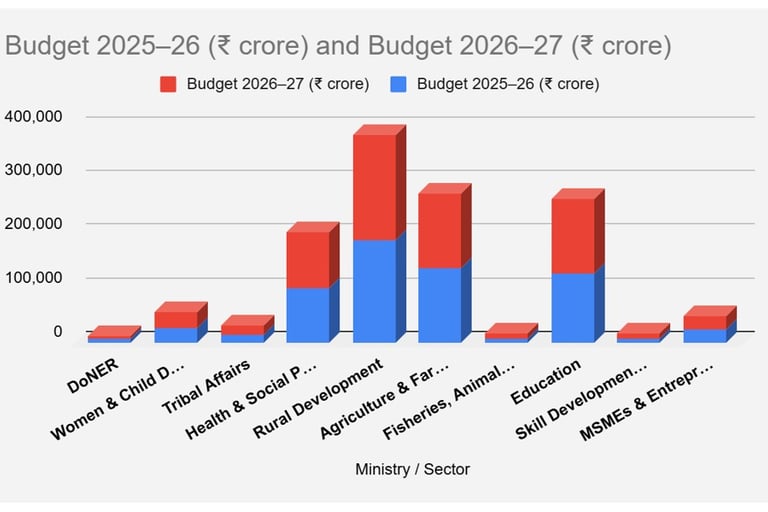
2025–26 Allocation: ₹5,915 crore
2026–27 Allocation: ₹6,812 crore (appx. 15% increase)
The Ministry of Development of North Eastern Region (DoNER) is the only central ministry with an exclusive geographical mandate and the increase in allocation in the budget 2026–27 shows the government’s acknowledgement that region-specific development requires predictable and expanding fiscal support.
2. Key Schemes
PM-DevINE: Focus on infrastructure, health, education, and livelihoods, particularly in aspirational districts and last-mile gaps.
NESIDS: Targeted funding for roads, power, water supply, and social infrastructure.
3. Comparative Insight
While Budget 2025–26 was focused on stabilising flagship initiatives, the Budget 2026–27 on the other hands strengthens its execution capacity. This shift from only creating assets to ensuring functional outcomes is important for the remote and border districts of the North-East.
Social Welfare Schemes: High Impact in the North-East
1.Women and Child Development
2025–26: ₹26,889 crore
2026–27: ₹28,183 crore
The Saksham Anganwadi and Poshan 2.0 scheme explicitly prioritises the North-East and aspirational districts, with enhanced nutrition cost norms.
Why it matters for NE:
High tribal population
Elevated levels of malnutrition and anaemia
Poor maternal and child health indicators
The continuity across both Budgets indicates recognition that human development deficits in the North-East are structural and require sustained intervention rather than one-time outlays.
2. Ministry of Tribal Affairs
2025–26: ₹14,925 crore
2026–27: ₹15,421 crore
With most North-Eastern states being tribal-majority, this ministry’s role often exceeds that of DoNER in social impact.
Focus Areas:
Tribal scholarships
Hostels and educational infrastructure
Forest-based livelihoods
Comparative View: Budget 2026–27 places greater stress on livelihoods and education consistency and aligning welfare with long-term socio-economic mobility.
3. Health and Social Protection
Health Ministry 2025–26: ₹99,858 crore
Health Ministry 2026–27: ₹1.06 lakh crore
NE-Relevant Interventions:
PM Jan Arogya Yojana
Day-care cancer centres at district hospitals
Digital health through PHCs
For a region where tertiary care access is limited by terrain and distance, district-level strengthening represents a decisive welfare shift.
Rural Economy, Agriculture and Livelihood Security
1. Ministry of Rural Development
2025–26: ₹1.90 lakh crore
2026–27: ₹1.97 lakh crore
Key Schemes:
MGNREGA
NRLM (women SHGs)
In the North-East where the economy is predominantly rural and informal—these schemes function as income stabilisers and social protection instruments.
2. Agriculture & Farmers Welfare
2025–26: ₹1.37 lakh crore
2026–27: ₹1.40 lakh crore
Relevant Interventions:
PM-KISAN
Rashtriya Krishi Vikas Yojana (RKVY)
Missions on pulses, fruits, vegetables, and natural farming
NE Advantage: The region’s low chemical intensity, horticulture potential, and suitability for organic farming align strongly with these missions. Budget 2026–27 further reinforces this by introducing technology-driven advisory systems and high-value crop support.
3. Fisheries, Animal Husbandry and Dairying
2025–26: ₹7,544 crore
2026–27: ₹8,915 crore
Riverine fisheries, piggery, and small-scale dairy offer critical livelihood diversification in the North-East. The increased allocation reflects a shift from subsistence to enterprise-oriented rural livelihoods.
Human Capital: Education, Skills and Youth
1. Education
2025–26: ₹1.28 lakh crore
2026–27: ₹1.39 lakh crore
NE-Specific Benefits:
Broadband connectivity to government schools
Digital education platforms
These measures will directly address teacher shortages and geographic isolation, long-standing barriers in the region.
2. Skill Development and Entrepreneurship
2025–26: ₹6,100 crore
2026–27: ₹9,885 crore
The sharp increase shows recognition of the North-East’s youth bulge and high migration pressures; thus, Skills here function not just as employability tools but also as social protection mechanisms.
3.MSMEs and Entrepreneurship
2025–26: ₹23,168 crore
2026–27: ₹24,566 crore
With micro and small enterprises dominating the NE economy, special focus on women-led, SC/ST, and rural MSMEs enhances inclusive growth and local value chains
Connectivity as Welfare: Structural Inclusion
Civil Aviation – UDAN
Both Budgets emphasise connectivity to hilly and North-Eastern districts through small airports and helipads.
In the North-East, connectivity directly determines access to:
Healthcare
Education
Markets and tourism
Thus, aviation policy functions as a social sector intervention rather than a luxury service.
Digital and Postal Infrastructure
Department of Posts
BharatNet
DBT-linked financial inclusion
Digital inclusion effectively substitutes physical proximity, enabling welfare delivery, telemedicine, and online education in remote habitations.
Comparative Assessment: 2025–26 vs 2026–27
Conclusion: Way Forward for the North-East
The comparative analysis shows a clear policy evolution. Budget 2025–26 laid the groundwork by strengthening welfare delivery and public investment whereas Budget 2026–27 builds upon this foundation by embedding technology, entrepreneurship, and regional specificity especially for the North-East.
Thus, all this shows a clear transition from welfare dependence to capability-led development. However, outcomes will ultimately depend on last-mile implementation, state capacity, and effective centre–state convergence but if executed well, the Budgets together mark a decisive step towards integrating the North-East as an equal partner in India’s journey towards Viksit Bharat.