The 16th Finance Commission (2026–31): Priorities, Principles and Policy Direction
The Finance Commission is a constitutional institution under Article 280 of the Indian Constitution, for the recommendation of the framework governing fiscal relations between the Union and the States. The 16th Finance Commission, chaired by Dr Arvind Panagariya, submitted its report for the five-year period from 2026–27 to 2030–31, which was tabled in Parliament on February 1, 2026. The report shows a clear attempt to balance fiscal equity, efficiency and macroeconomic stability while responding to evolving developmental and governance challenges faced by Indian states.
Centre–State Tax Devolution
One of the most important recommendations of the 16th FC is the retention of the 41% share of states in the divisible pool of central taxes. It was the same level as recommended by the 15th Finance Commission. The divisible pool excludes cesses, surcharges and the cost of tax collection, thereby defining the portion of central tax revenue that is shared with states. By maintaining continuity in the vertical devolution ratio, the Commission has prioritised predictability and stability in fiscal transfers which is particularly important for state-level budget planning and medium-term budgetary frameworks.
Criteria for Horizontal Devolution
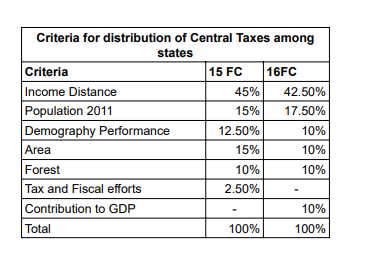
Though the vertical share remains unchanged, the horizontal distribution formula that determines how the 41% share is distributed among individual states has undergone notable adjustment. The Commission continues to stress equity through the income distance criteria, though its weight has been marginally reduced. Income distance is calculated as the gap between a state’s per capita Gross State Domestic Product (GSDP) and the average per capita GSDP of the top three large states. States with lower income levels therefore receive a higher share, reinforcing the redistributive role of fiscal transfers.
The weight assigned to population (2011 Census) has been increased showcasing the continued importance of demographic size in expenditure needs. At the same time, the demographic performance criterion has been redefined as well. Instead of relying on Total Fertility Rate (TFR), the Commission now measures population growth between 1971 and 2011, thus rewarding states that have successfully controlled population expansion over a longer historical period. This attempts to balance concerns of fairness between states that undertook early demographic transitions and those still managing higher population growth.
The treatment of forest cover has also been broadened. The 16th FC accounts not only for a state’s share in total forest area but also for the increase in forest area cover over recent years including open forests. This represents a shift towards recognising ecological services and conservation efforts as part of fiscal federalism.
A major change in the horizontal devolution is the introduction of contribution to GDP as a criterion that replaces the earlier parameter of tax and fiscal effort. By factoring this in a state’s contribution to national economic output, the Commission acknowledges the role of economically stronger states in driving national growth, while still maintaining the redistributive focus of the overall formula.
Grants-in-Aid Framework
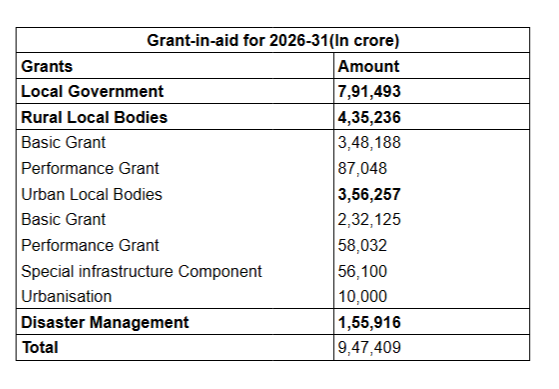
Beyond tax devolution, the 16th FC recommends grants-in-aid totalling approximately ₹9.47 lakh crore over the five years. A defining feature of this report is the streamlining of grants, with the Commission discontinuing revenue-deficit grants, sector-specific grants, and state-specific grants that were in place under the 15th FC. This signals a clear shift away from ad hoc or fragmented transfers towards a more rule-based and outcome-oriented grants system.
The bulk of grants is directed towards local governments, both rural and urban, underscoring the Commission’s emphasis on grassroots governance and decentralisation. Grants to local bodies are divided into basic grants and performance-based grants, with an overall structure that encourages transparency, accountability, and fiscal effort at the sub-state level.
Access to these grants is conditional upon meeting entry-level governance criteria, such as the constitution of local bodies in accordance with constitutional provisions, timely publication of audited accounts, and the regular establishment of State Finance Commissions. These conditions reflect the Commission’s insistence on institutional strengthening as a prerequisite for fiscal support.
Urban Focus and Infrastructure
Within urban local body grants, the Commission introduces two notable components: Special Infrastructure Grants and an Urbanisation Premium. Special Infrastructure Grants are targeted at cities with populations between 10 and 40 lakh and are specifically tied to the development of comprehensive wastewater management systems. This reflects growing concerns around urban sustainability, public health, and environmental management.
The Urbanisation Premium is a one-time incentive designed to support states that undertake the merger of peri-urban villages into urban local bodies and formulate clear rural-to-urban transition policies. Through this, the Commission acknowledges the structural transformation underway in India’s spatial and demographic landscape.
Disaster Management
The report recommends a robust disaster management collection for State Disaster Relief and Management Funds. The cost-sharing pattern continues to recognise regional vulnerabilities, with a higher central share for northeastern and Himalayan states. This approach reinforces the principle of differentiated responsibility based on exposure to natural disasters and fiscal capacity.
Fiscal Roadmap and Debt Sustainability
A key macroeconomic concern addressed by the 16th FC is fiscal consolidation. The Commission recommends that the central government reduce its fiscal deficit to 3.5% of GDP by 2030–31 while states should stick to a 3% fiscal deficit ceiling relative to GSDP. Importantly, the report calls for the strict discontinuation of off-budget borrowings urging that all liabilities be transparently reflected in budget documents.
The Commission also recommends expanding the definition of fiscal deficit and public debt to include off-budget borrowings. This is aimed at improving fiscal transparency and ensuring more accurate assessments of debt sustainability. As a result of these measures, the combined debt of the Centre and states is projected to decline gradually over the award period.
Structural Reforms: Power Sector, Subsidies, and Public Enterprises
The 16th FC adopts a reform-oriented stand on structural inefficiencies mainly in the power sector as it strongly encourages states to pursue the privatisation of electricity distribution companies (DISCOMs) with safeguards to manage legacy debt through special purpose vehicles. Access to certain central assistance schemes is made conditional on completing privatisation, signalling a clear policy preference.
On subsidy expenditure, the Commission highlights concerns over poorly targeted and unconditional cash transfers. It recommends rationalisation of subsidies, clearer exclusion criteria, and an end to financing subsidies through off-budget mechanisms. The report also flags inconsistencies in how subsidies are classified across states and calls for standardised accounting and disclosure practices.
Finally, the Commission addresses the issue of State Public Sector Enterprises (SPSEs). It recommends the closure or disinvestment of inactive and chronically loss-making enterprises and urges states to adopt clear PSE disinvestment policies. Enterprises incurring losses over multiple years are to be reviewed at the cabinet level, ensuring political accountability in decisions related to public assets.
Conclusion
Overall the 16th Finance Commission report shows a huge shift towards fiscal discipline, transparency and performance-linked central transfers while retaining the core redistributive logic of India’s fiscal federalism. By rebalancing devolution criteria, streamlining grants, and pushing for long-pending structural reforms, the Commission seeks to align intergovernmental finance with India’s evolving economic and governance priorities for the next decade